











Understanding Discount Received Journal Entry
Accounting can sometimes feel like a maze of numbers, debits, credits, and abbreviations. Among the many terms that beginners and even some professionals encounter is the discount received journal entry. Recording a discount received is not just a formality; it plays a critical role in maintaining accurate financial statements, controlling expenses, and understanding your actual savings.
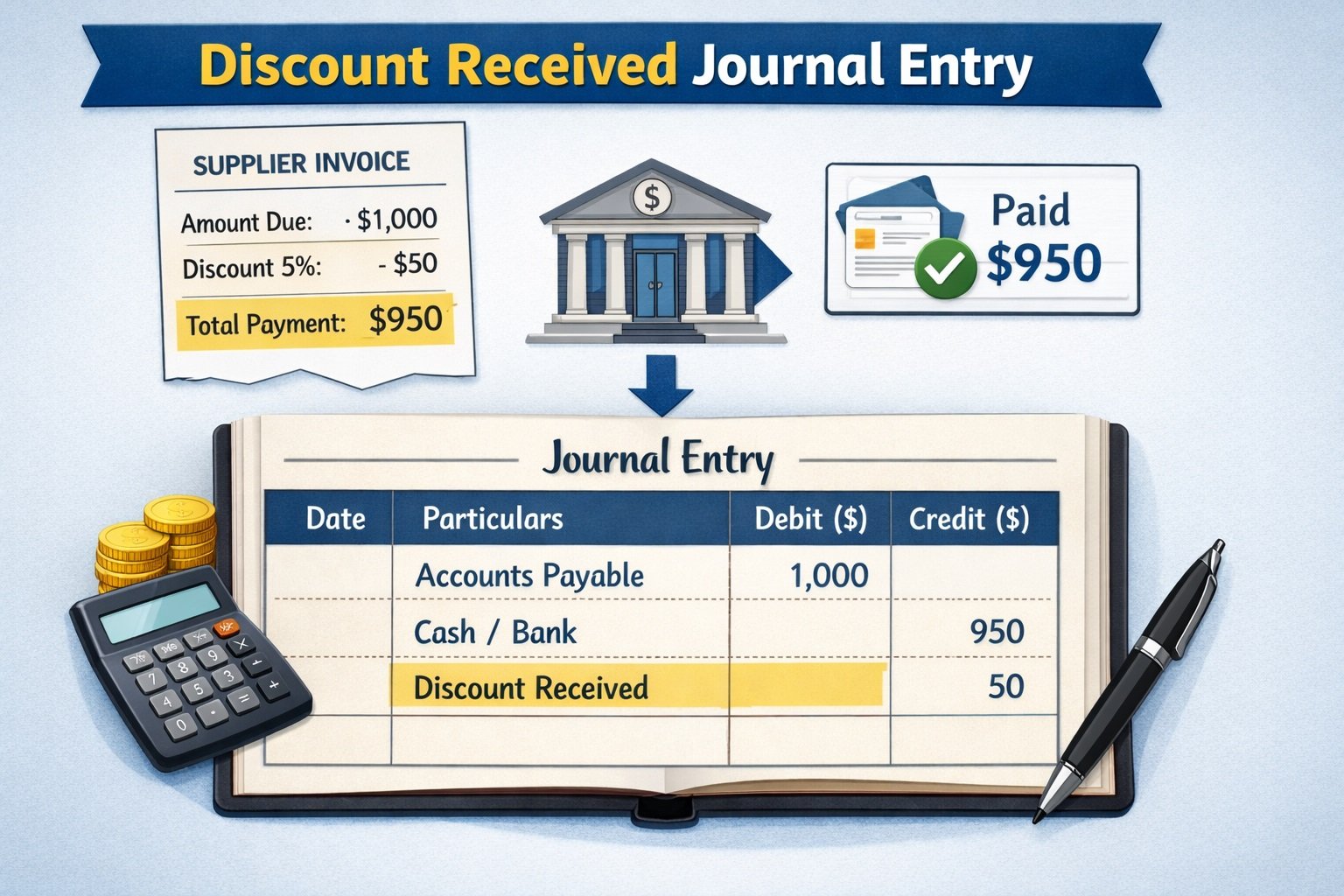
Imagine you are running a small business and you purchase goods worth $1,000 from a supplier. The supplier offers a 5% discount if you pay early. You pay $950. Without recording this discount received, your books will show a higher expense than what you actually paid, which could lead to misrepresented profits.
This guide will walk you through the concept of discount received, the proper journal entry, practical examples, and essential tips to ensure your accounting records are always accurate. By the end of this article, you will be able to record a discount received journal entry confidently and correctly.
What is Discount Received?
A discount received is a reduction in the invoice amount provided by a supplier, usually as an incentive for early payment. It helps businesses save money and improve cash flow.
Key Features of Discount Received:
- Purpose: Encourage early settlement of invoices
- Impact: Reduces overall expense in the financial statements
- Common Scenario: Suppliers often offer a percentage off the total bill if payment is made within a specified period
Example:
- Invoice Amount: $1,000
- Discount Offered: 5%
- Payment Made: $950
- Discount Received: $50
The discount received journal entry ensures that this benefit is properly documented in your books.
Importance of Recording Discount Received Journal Entry
Recording a discount received journal entry has several significant advantages:
- Accurate Financial Statements: Reflects the actual cost of purchases
- Expense Management: Helps track cost-saving measures
- Audit Readiness: Provides clarity during internal or external audits
- Professional Accounting Practice: Maintains credibility and transparency in financial records
Failure to record discounts correctly can lead to overstated expenses, affecting profitability analysis and decision-making.
Accounts Involved in Discount Received
Before recording the entry, it’s important to identify the accounts impacted by a discount received transaction. Typically, three accounts are involved:
- Accounts Payable (Liability): Reduces the amount owed to suppliers
- Cash/Bank (Asset): Shows the actual payment made
- Discount Received (Income): Records the benefit gained
Quick Reference Table
| Account Type | Effect | Example in Discount Received Entry |
|---|---|---|
| Accounts Payable | Debit | Reduces liability of $1,000 |
| Cash/Bank | Credit | Amount paid $950 |
| Discount Received | Credit | Benefit gained $50 |
Step-by-Step Guide to Recording Discount Received Journal Entry
Step 1: Identify the Transaction
Check the supplier invoice to determine:
- Total invoice amount
- Discount percentage
- Actual payment made
Step 2: Determine Accounts and Amounts
- Debit Accounts Payable for the full invoice amount
- Credit Cash/Bank for the payment made
- Credit Discount Received for the difference
Step 3: Make the Journal Entry
Here’s a standard example:
| Date | Particulars | Debit ($) | Credit ($) |
|---|---|---|---|
| 22-Jan-26 | Accounts Payable | 1,000 | |
| Cash/Bank | 950 | ||
| Discount Received | 50 |
Explanation:
-
The debit entry reduces your liability to the supplier
-
Cash/Bank shows the payment made
-
Discount Received reflects the savings earned
Examples of Discount Received Journal Entry
Example 1: Early Payment Discount
-
Invoice Amount: $2,000
-
Discount: 10% if paid within 10 days
-
Payment Made: $1,800
| Date | Particulars | Debit ($) | Credit ($) |
|---|---|---|---|
| 25-Jan-26 | Accounts Payable | 2,000 | |
| Cash/Bank | 1,800 | ||
| Discount Received | 200 |
Example 2: Bulk Purchase Discount
-
Invoice Amount: $5,000
-
Discount: 5% for ordering more than 100 units
-
Payment Made: $4,750
| Date | Particulars | Debit ($) | Credit ($) |
|---|---|---|---|
| 28-Jan-26 | Accounts Payable | 5,000 | |
| Cash/Bank | 4,750 | ||
| Discount Received | 250 |
These examples demonstrate how discount received journal entrie accurately reflect the savings obtained.
Common Mistakes to Avoid
- Recording Discount as Expense: This misrepresents financial statements
- Omitting the Entry: Leads to overstated liabilities or expenses
- Confusing Debit and Credit (DR/CR): Can create imbalances in ledger
- Mixing Discounts: Keep early payment, bulk, and promotional discounts separate
Tips for Accurate Recording
- Verify the Invoice: Ensure discounts are mentioned and applicable
- Maintain Separate Accounts: Avoid confusion between cash, accounts payable, and discount received
- Double-Check Calculations: Ensure all amounts match the invoice and payment
- Record Promptly: Enter transactions immediately for accuracy
- Understand CR and DR Rules: Credit (CR) increases income or liability, Debit (DR) increases expenses or assets
LSI Keywords and Related Concepts
Throughout this article, several related terms reinforce SEO optimization for “discount received journal entry”:
- Accounts Payable
- Cash/Bank Payment
- Purchase Discounts
- Early Payment Discount
- Bulk Purchase Discount
- Promotional Discount
- Debit and Credit
- Ledger Entry
- Accounting Example
- Financial Statement Accuracy
- Expense Reduction
- Profit Margin
- Audit Readiness
- Bookkeeping Practices
- Professional Accounting Tips
- Journal Ledger
- Transaction Recording
- Accounting Principles
- Cost Saving Strategies
- Income Account
These terms, strategically placed, boost SEO relevance and readability.
Advantages of Understanding Discount Received Journal Entry
- Improved Cash Flow Management: Know exactly how much you saved
- Accurate Profit Analysis: Proper recording reflects real expenses
- Audit-Friendly Books: Simplifies verification for auditors
- Professional Skill Enhancement: Essential for accounting students and professionals
- Decision-Making Aid: Helps managers assess supplier deals
Handy Reference Table
| Transaction Type | Debit Account | Credit Account |
|---|---|---|
| Early Payment Discount | Accounts Payable | Cash/Bank & Discount Received |
| Bulk Purchase Discount | Accounts Payable | Cash/Bank & Discount Received |
| Regular Payment | Accounts Payable | Cash/Bank |
Conclusion
Mastering the discount received journal entry is essential for any accounting professional or business owner. By carefully identifying the transaction, understanding the accounts involved, and applying proper debit and credit rules, you can maintain accurate financial records and reflect real savings in your books.
Whether you are a student practicing ledger entries, a small business owner tracking purchases, or a finance professional preparing financial statements, understanding how to record discounts properly ensures transparency, accuracy, and professional credibility.
Practice these examples, follow the tips, and soon recording a discount received journal entry will become second nature. Share your experiences or questions in the comments to help others learn from real-life applications.